Live Casino Acts and Screen Spectacle Create Different Kinds of Attention
Compare live casino acts and screen spectacle by how performers handle sound, timing, audience response, and space, so you can identify each form’s craft.
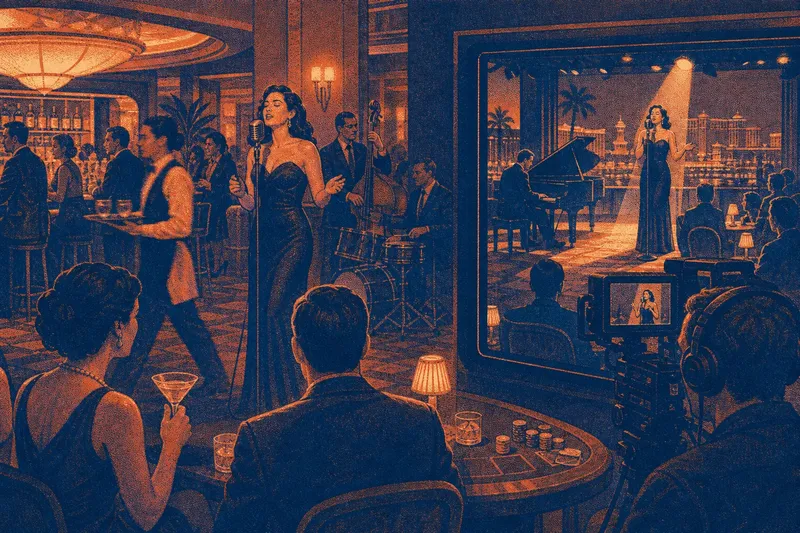
The common mistake in comparing live casino acts and screen spectacle is to treat the filmed version as a portable stage show. That misses the central difference: a live act must work with a room that keeps behaving like a room, while a screen performance is built around a chosen setting, cast, and sequence of events.
Conditions of performance
In a casino lounge, a singer shares the space with conversation, service, and movement. The performer can adjust a pause or extend a musical phrase, but cannot remove a passing server or ask every guest to stop talking. The audience also decides how much attention to give the stage.
A screen production begins with a different task. Actors perform in a location chosen or dressed for the scene, and the finished sequence combines performance with music, sound, and editing. The casino can be recreated, simplified, or implied through a few deliberate details. The craft lies partly in making those choices cohere, rather than in managing an unruly room in real time.
Neither form is inherently more authentic. A live singer may work within a tightly rehearsed set, while a filmed performance may preserve a spontaneous-looking exchange through careful acting and staging. The useful question is what each form asks its performers to respond to.
Room as collaborator
Live casino entertainment is shaped by the venue’s acoustics and layout. A stage near a bar faces different distractions from one tucked into a separate lounge. Speaker placement affects whether lyrics carry across the room, and a low platform may leave some guests with an obstructed view.
Performers and stage managers can address some of these conditions through blocking, amplification, and cueing. A broad gesture may remain readable from farther away; a quiet vocal passage may need a carefully balanced sound system. These are not merely technical details. They influence what kind of performance the room can support.
On screen, a casino setting is constructed for a particular scene. A piano, a bank of lights, or the murmur of guests can establish the location without showing every corner. Unlike a live venue, the fictional space need not accommodate its audience. It only needs to serve the sequence.
Music and timing
A live musical act unfolds at the pace of the performers and the room. A band may hold a transition while a singer crosses the stage, or leave a pause long enough for audience response. The timing can vary from one performance to the next because the event is still in progress.
A screen sequence can join separate takes, alter the order of moments, or carry music across a change in location. That flexibility helps create a clear dramatic arc, but it changes how the musical event is represented. The viewer hears a composed sequence, not the full set of conditions under which each part was performed.
A useful comparison is a handwritten note beside a printed program. The note records a moment as it happened; the program arranges information for a planned reading. Neither tells the whole story, but each makes different details easy to follow.
Audience and character
In a live casino act, the audience is physically present and can respond in ways the performer notices. Applause, a quiet room, or scattered conversation may affect delivery. The audience is part of the event’s atmosphere, even when no one onstage addresses it directly.
In a screen scene, audience members are usually represented by selected performers or by the general sound of a crowd. Their responses help establish whether the room feels celebratory, indifferent, or tense. Because those responses are written and staged, they function as part of the scene’s dramatic design rather than as an uncontrolled audience reaction.
For a viewer, the distinction is not a contest between “real” and “fake.” It is a question of whose behavior drives the moment: the guests sharing a live event, or characters whose reactions have been arranged to support a story.
How to compare the craft?
What should I notice about live casino music?
Listen for how the performer handles room noise, transitions, and audience response. If a pause changes after applause or conversation, the room has affected the timing of the act.
How does a screen scene establish a casino?
Notice which details do the work: music, set dressing, background movement, or dialogue. A scene may suggest a busy venue with a few carefully chosen sounds and objects rather than showing the whole floor.
Why do live performances vary?
Performers share the event with an audience and a venue whose conditions can shift from one occasion to another. A different response or interruption may lead to a different pause, transition, or delivery.
What does editing change?
Editing can join performances and sounds recorded at different times into one sequence. This allows a screen scene to control its pace, while a live act must carry its transitions in the moment.
Practical comparison
When comparing a live act with a screen performance, focus on observable decisions rather than vague impressions such as “polished” or “authentic.” These checks help identify what is shaping the experience:
- Sound: If live lyrics compete with conversation, note whether amplification or the singer’s delivery keeps them intelligible; if not, compare whether the screen version uses music or dialogue to establish the same moment.
- Venue: If guests move through the live space, decide whether the act incorporates that movement or works around it; if a screen scene excludes such activity, notice what atmosphere the quieter setting creates.
- Timing: If a live transition changes after applause, treat audience response as part of the performance; if a screen transition stays fixed, consider how the planned sequence directs the scene.
- Blocking: If a performer crosses a busy part of the stage, check whether the path remains clear; if it does not, note whether the gesture or placement still communicates the intended action.
- Audience behavior: If guests respond in different ways, decide whether the performer acknowledges them or continues the planned set; if screen characters respond in unison, notice how that makes the crowd feel designed.
- Setting: If the live venue’s furnishings or acoustics affect the act, include them in your judgment; if a screen setting uses only a piano, lighting, and crowd sound, decide what kind of casino atmosphere those details imply.
Say a fictional casino lounge has a singer beginning a quiet number while a group near the bar is talking. The singer pauses before the first verse, then resumes when the group quiets; the observable result is that the interruption becomes part of the live timing, though the singer has less control over how long it lasts. Now imagine a fictional screen scene with the same starting conditions: a singer, a talking group, and a quiet opening. The director stages the group’s conversation, the actors perform the pause, and the editor places the return to the singer after the room falls silent. The resulting scene presents a defined interruption, but its timing reflects the planned sequence rather than an audience’s unpredictable response.
What makes each form distinct?
Live casino acts depend on performers coordinating with a venue and the people in it. Screen performances depend on actors, set design, music, and editing working together to create a finished scene. Both can be carefully composed; they differ in what can alter the composition while it is underway.
For a more precise comparison of live casino acts and screen spectacle, identify the moment that shaped your impression: a band adjusting a transition, a singer responding to conversation, or a scripted scene arranging a musical entrance. That detail tells you whether the performance’s character came from the room’s behavior or from the choices used to build the scene.